Case Study
Designing a compliant identity and support system for a multi-role SaaS platform

Product Context
Strengthening a Multi-Role SaaS Foundation
Proteus Motion is a hardware-enabled performance training system used in sports facilities. Its software supports athletes, trainers, and administrators—often operating on shared devices with long-lived accounts tied to performance data. As the platform scaled, identity capture, age compliance, and in-product support became critical to system reliability and data integrity.
Platforms
Android App · Web
Team
Product Design · Engineering · Legal · Customer Success
Duration
Multiple initiatives across several months
Problem
Foundational Gaps in Identity and Support
The existing sign-up flow wasn’t designed for multi-role complexity or evolving compliance requirements. Profiles were often incomplete, responsibility boundaries were unclear, and age restrictions were unenforced.
With COPPA requirements in place, the system needed to prevent users under 13 from creating or maintaining accounts—without disrupting live training workflows on shared devices.
This required rethinking identity as system architecture, not just onboarding.
Identity & Compliance
Designing a Role-Aware, Age-Compliant System
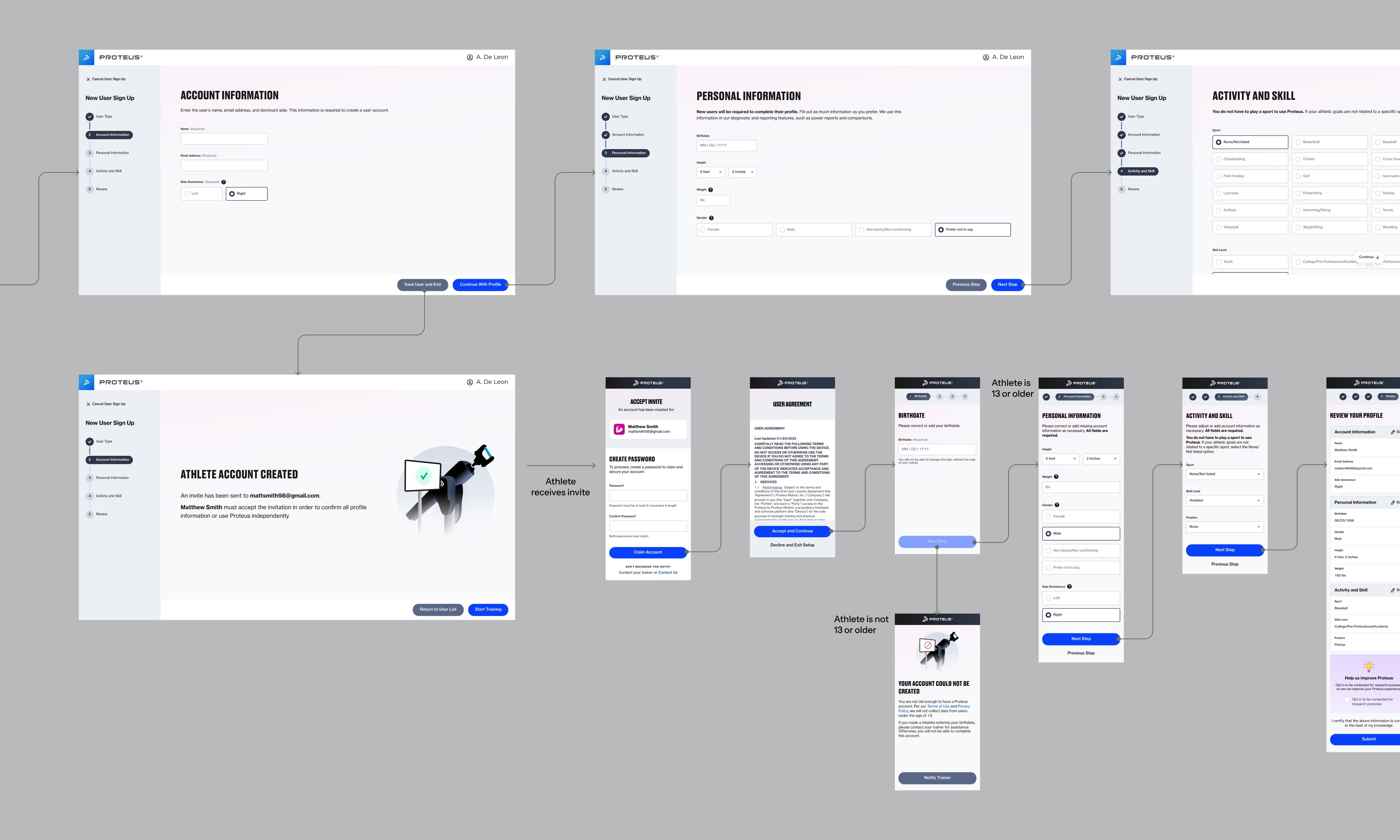
I redesigned sign-up as a structured identity model that enforces age eligibility across every creation path. Trainers initiate accounts on shared kiosks, while athletes complete personal details on their own devices. Supervised accounts remain explicitly trainer-managed.
Age enforcement is embedded across the account lifecycle rather than introduced as a single blocking gate.


Remediating Existing Accounts
Compliance extended beyond new users. Many accounts predated age capture requirements.
Instead of introducing a disruptive checkpoint, I designed a staged interception model. Birthdate prompts appear at login or trainer access. Verification occurs outside active sessions. Underage accounts are restricted, with correction paths available before removal.
This approach balanced legal enforcement with operational continuity.

In-Product Help System
Embedding Support Into Real Workflows
Proteus previously relied on external documentation hosted outside the product. There was no contextual support during setup, calibration, or account management.
I reframed Help as workflow support rather than a traditional help center. It needed to function before login, during sessions, and across shared devices—without interrupting primary tasks.
Exploration & Structural Tradeoffs
Two structural directions were explored: a comprehensive long-scroll layout and a lightweight modal grouped by category.
The long-scroll direction required content infrastructure that didn’t yet exist. The modal system allowed us to ship contextual support quickly while establishing a scalable foundation.

Final Help Architecture
Help ships as a persistent modal accessible throughout the product. Where global navigation is unavailable, including boot screens and restricted states, a reduced modal still surfaces core support.
Introducing Help required refining navigation across user roles, login states, and connectivity conditions—strengthening clarity without expanding into a full navigation overhaul.


Outcome
Reinforcing Platform Integrity
Together, these initiatives established a compliant, role-aware identity system and embedded contextual support directly into the product. Age enforcement now operates across new and existing accounts, responsibility boundaries are explicit, and help is accessible at the moment of need.
This work strengthened data integrity, reduced operational friction, and improved long-term platform reliability.